
Sleep patterns are the recurring habits that shape when you sleep, how long you sleep, and how consistently you wake. If you feel tired or sleep poorly, stress may contribute—but it is not the only possible explanation. Irregular schedules, insufficient sleep, circadian misalignment, insomnia, and sleep-disordered breathing can all play a role. The Centers for Disease Control and Prevention (CDC) says adults generally need at least seven hours of sleep per night, yet about one in three U.S. adults reports sleeping less than that. Looking at sleep timing, duration, continuity, and symptoms can help you decide what to change and when to seek medical advice.
Sleep patterns reveal more than stress alone
A sleep pattern is the observable rhythm and quality of a person’s sleep over time: when sleep begins and ends, how long it lasts, how often it is interrupted, and whether it feels restorative. The American Academy of Sleep Medicine (AASM) and Sleep Research Society recommend that adults regularly sleep at least seven hours per night for optimal health; individual needs vary, and sleep quality matters alongside duration.
Stress can disrupt sleep, but treating every restless night as “just stress” may obscure a schedule problem, a health condition, medication effects, or a sleep disorder. The National Heart, Lung, and Blood Institute (NHLBI) describes insomnia as difficulty falling asleep, staying asleep, or getting good-quality sleep despite having adequate opportunity to sleep, especially when it affects daytime functioning. The pattern—when symptoms happen and how long they persist—offers useful clues, though it cannot establish a diagnosis by itself.
Sleep duration and regularity define a key sleep-pattern attribute
Sleep duration is the total time spent asleep, while regularity describes how consistently sleep and wake times occur. The CDC recommends at least seven hours for adults ages 18–60, seven to nine hours for adults ages 61–64, and seven to eight hours for adults 65 and older. These are population-level recommendations, not a guarantee that a particular number will suit every person.
Duration and regularity are related but distinct: someone may spend enough hours in bed yet sleep at widely varying times, or keep a consistent schedule while regularly getting too little sleep. A 2023 scientific statement from the American Heart Association identifies sleep duration, regularity, timing, continuity, and satisfaction as relevant dimensions of sleep health. Tracking them together gives a fuller picture than focusing on stress alone.
Short sleep and accumulated sleep debt
Short sleep means routinely getting less sleep than the body needs. Early starts, long shifts, caregiving, late-night screen use, and social commitments can all compress sleep opportunity. The CDC reports that roughly one in three U.S. adults does not get the recommended minimum of seven hours. Persistent sleep restriction may affect alertness, mood, and concentration; feeling accustomed to short nights does not necessarily mean the effects have disappeared.
A practical first check is whether the available sleep window is long enough. Record bedtime, estimated time to fall asleep, awakenings, final wake time, and naps for one to two weeks. If the schedule repeatedly leaves too little opportunity for sleep, changing that window may be more relevant than attributing fatigue solely to emotional stress.
Irregular sleep timing and social jet lag
Irregular timing occurs when sleep and wake times shift substantially from day to day. A common example is staying up late and sleeping in on weekends after early weekday mornings. This mismatch between a person’s work or school schedule and their preferred body clock is often called social jet lag. It can make Monday mornings feel especially difficult and may leave a person feeling unrested even when weekend sleep is longer.
The NHLBI notes that keeping a consistent sleep schedule is part of healthy sleep habits. A steady wake time, including on days off where practical, can help anchor the daily rhythm. Shift workers and people with unavoidable schedule changes may need individualized advice rather than a one-size-fits-all routine.
Sleep continuity and timing point to different causes
Sleep continuity refers to staying asleep with few or brief awakenings; sleep timing refers to when sleep occurs relative to the body’s internal clock and daily obligations. Both can be disrupted by stress, but they can also be affected by pain, breathing problems, caffeine, alcohol, medications, environmental noise, or circadian rhythm disorders. Noting whether the main issue is falling asleep, waking repeatedly, or waking too early can help guide a conversation with a clinician.
Difficulty falling asleep or returning to sleep
Insomnia symptoms include trouble initiating sleep, repeated awakenings, or waking earlier than intended, with daytime consequences such as fatigue or impaired concentration. The NHLBI distinguishes occasional sleep difficulty from chronic insomnia disorder, which involves sleep problems at least three nights a week for three months or longer, despite adequate opportunity to sleep. A diary can help identify whether the difficulty tracks with schedule changes, substances, symptoms, or recurring worry.
For chronic insomnia, cognitive behavioral therapy for insomnia (CBT-I) is a recommended first-line treatment in major clinical guidance. It is a structured therapy, not simply generic advice to “relax.” A health professional can assess whether CBT-I or another approach is appropriate and check for contributing conditions.
Delayed or advanced body-clock timing
Circadian rhythm sleep-wake disorders occur when the internal timing system is out of alignment with required sleep and wake times. With delayed sleep-wake phase, a person may naturally fall asleep and wake much later than work or school allows; with advanced sleep-wake phase, sleepiness and waking may arrive unusually early. The pattern can be mistaken for poor discipline or stress, especially when sleep is more normal on a preferred schedule.
Light exposure, daily routines, and planned schedule changes can affect circadian timing, but treatment should be tailored. The American Academy of Sleep Medicine’s clinical practice guidance discusses timed light and other interventions for selected circadian disorders. Seek professional advice before using light therapy or melatonin, because timing and individual health factors matter.
Sleep symptoms can signal a disorder rather than stress
Sleep disorders are conditions that persistently interfere with sleep or daytime functioning. A person can experience stress and a sleep disorder at the same time; one does not rule out the other. Persistent symptoms, loud snoring, gasping, or severe daytime sleepiness deserve attention because sleep apnea and other conditions may require specific assessment and treatment.
Snoring, gasping, and obstructive sleep apnea
Obstructive sleep apnea (OSA) involves repeated narrowing or closure of the upper airway during sleep, disrupting breathing and sleep. Common clues include loud habitual snoring, witnessed pauses in breathing, gasping or choking at night, and daytime sleepiness. The American Academy of Sleep Medicine estimates that OSA affects nearly 30 million adults in the United States, while many cases remain undiagnosed. Snoring alone does not prove apnea, but breathing pauses or persistent sleepiness warrant medical evaluation.
Restless legs and repeated limb movements
Restless legs syndrome (RLS) is characterized by an urge to move the legs, often with uncomfortable sensations, that typically worsens during rest and in the evening and improves temporarily with movement. It can delay sleep or repeatedly interrupt it. The National Institute of Neurological Disorders and Stroke notes that RLS can range from mild to severe and may be associated with factors such as iron deficiency, pregnancy, or certain chronic conditions. A clinician can assess symptoms and decide whether testing or treatment is needed.
When a sleep diary or assessment is useful
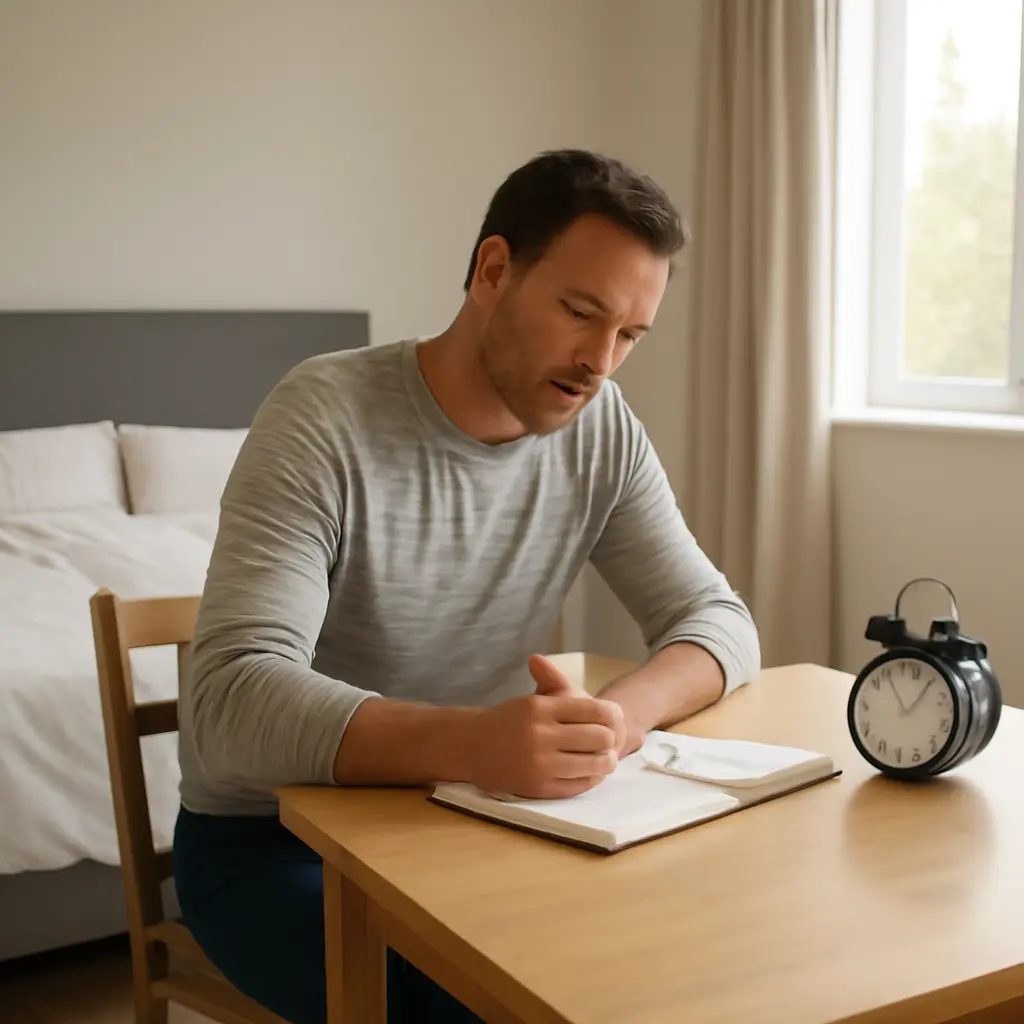
A sleep diary records bedtime, wake time, awakenings, naps, caffeine or alcohol use, and how alert you feel during the day. The American Academy of Sleep Medicine describes sleep diaries as a useful tool for documenting sleep patterns, including in the assessment of insomnia and circadian timing concerns. Wearables can offer estimates, but they do not diagnose sleep disorders and may not accurately distinguish sleep stages for an individual.
Bring a diary to a healthcare appointment if sleep problems are frequent, last several weeks, or interfere with daily life. A clinician may review medications and health history, ask about breathing or movement symptoms, and determine whether a sleep study or other evaluation is appropriate.
A practical way to check sleep before blaming stress
A brief, structured review can reveal patterns without turning sleep tracking into another source of worry. Consider these steps:
- Keep a one- to two-week sleep diary, including workdays and days off.
- Check whether your sleep opportunity regularly meets the age-appropriate recommendation.
- Compare weekday and weekend bedtimes and wake times for large shifts.
- Note awakenings, snoring or gasping, leg sensations, naps, and daytime sleepiness.
- Review caffeine, alcohol, nicotine, medications, pain, and bedroom conditions with a healthcare professional when relevant.
- Seek care for persistent symptoms, dangerous sleepiness, or signs of disrupted breathing rather than relying on self-diagnosis.
For example, a person who sleeps five hours on work nights and catches up on weekends may have insufficient sleep opportunity and an irregular schedule, even during a stressful period. Someone who allows enough time for sleep but repeatedly wakes gasping needs assessment for possible breathing-related disruption. These examples illustrate why the pattern matters; neither can be diagnosed from a schedule alone.
Conclusion: check the pattern, then address stress and health together
Sleep duration and regularity reveal whether enough sleep is available and whether timing is consistent. Continuity and circadian timing help distinguish difficulty staying asleep from a body-clock mismatch, while symptoms such as gasping, loud snoring, or restless legs may point toward a sleep disorder. Stress can be part of the picture, but it should not automatically be treated as the whole explanation.
Track sleep for a short, manageable period and discuss persistent or concerning symptoms with a healthcare professional. This can support earlier recognition of treatable problems and a more useful conversation about stress, routines, and overall health.
Sources: Centers for Disease Control and Prevention, About Sleep, https://www.cdc.gov/sleep/about/index.html; Watson NF et al., Recommended Amount of Sleep for a Healthy Adult: A Joint Consensus Recommendation of the American Academy of Sleep Medicine and Sleep Research Society, https://jcsm.aasm.org/doi/10.5664/jcsm.4758; American Heart Association, Sleep Duration and Quality: Impact on Lifestyle Behaviors and Cardiometabolic Health, https://www.ahajournals.org/doi/10.1161/CIR.0000000000001084; National Heart, Lung, and Blood Institute, Insomnia, https://www.nhlbi.nih.gov/health/insomnia; National Heart, Lung, and Blood Institute, Healthy Sleep Habits, https://www.nhlbi.nih.gov/health/sleep-deprivation/healthy-sleep-habits; Edinger JD et al., Behavioral and Psychological Treatments for Chronic Insomnia Disorder in Adults: An American Academy of Sleep Medicine Clinical Practice Guideline, https://jcsm.aasm.org/doi/10.5664/jcsm.8986; American Academy of Sleep Medicine, Circadian Rhythm Sleep-Wake Disorders, https://aasm.org/clinical-resources/practice-standards/practice-guidelines/; American Academy of Sleep Medicine, Sleep Apnea, https://aasm.org/resources/factsheets/sleepapnea.pdf; National Institute of Neurological Disorders and Stroke, Restless Legs Syndrome, https://www.ninds.nih.gov/health-information/disorders/restless-legs-syndrome; American Academy of Sleep Medicine, The Sleep Diary, https://sleepeducation.org/resources/sleep-diary/.